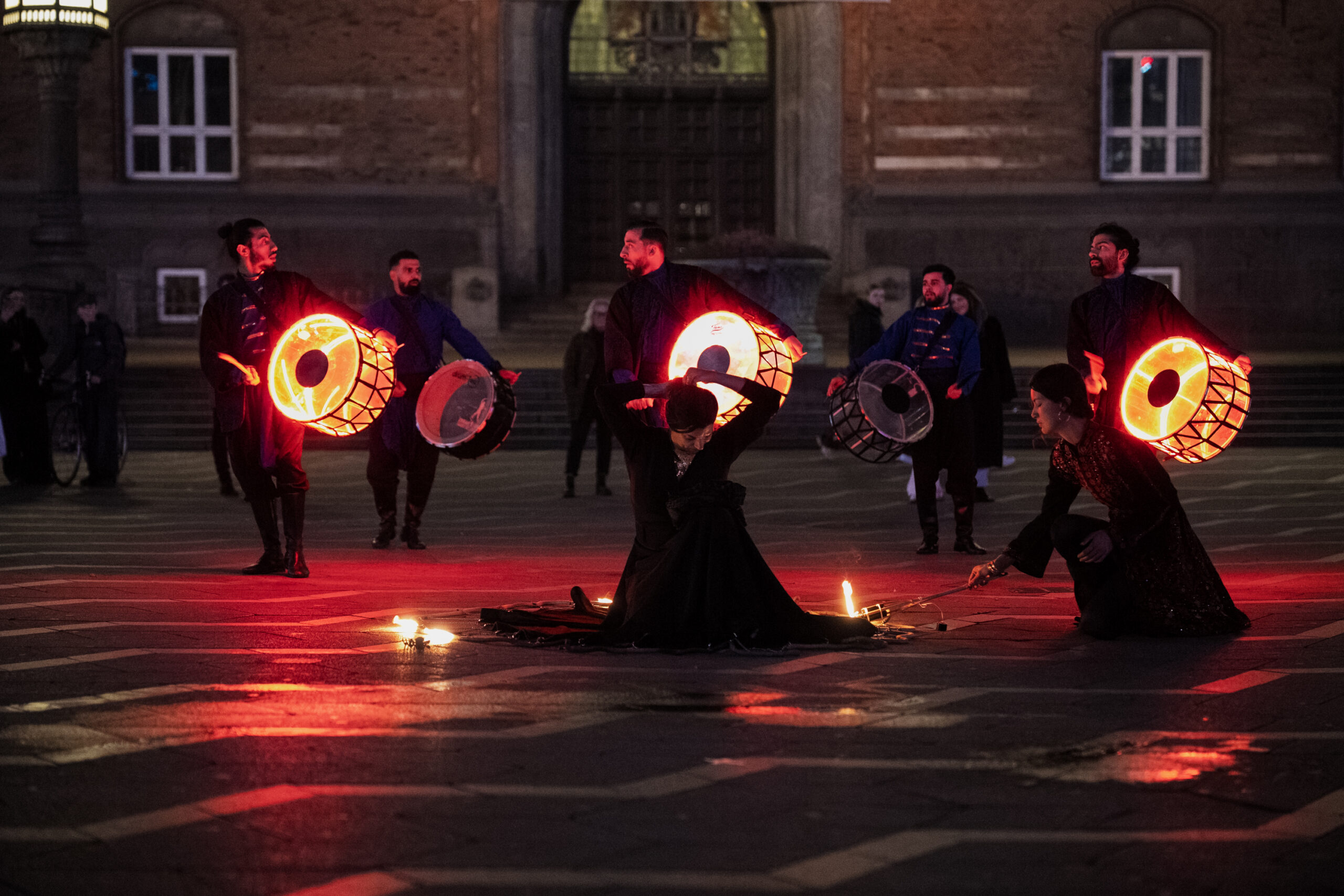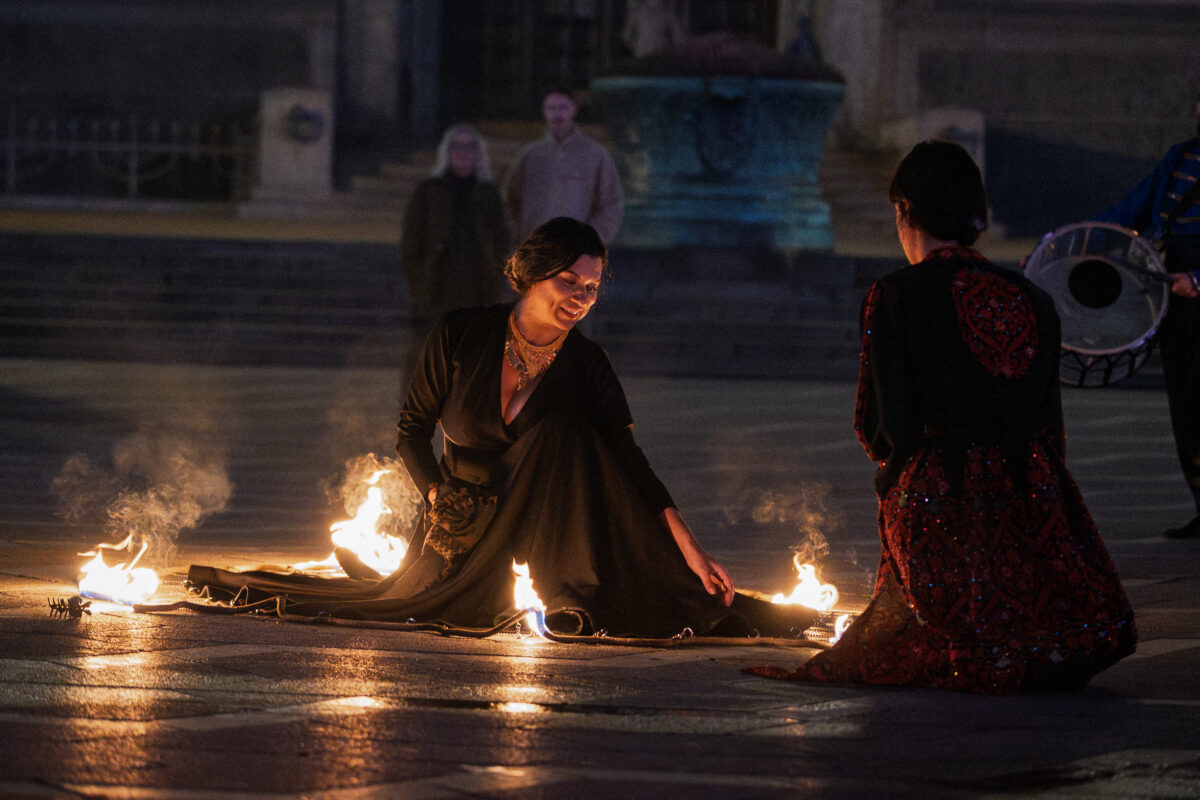
From Politiken’s Forhal to City Hall Square and Borups Plads, Lina Hashim lets cultural traditions and media imagery collide in public space. In a new total installation created specifically for Politiken’s Forhal, Hashim unfolds visual and linguistic representations of women with a Muslim cultural background within a Danish media landscape. As a performance artist, Hashim embodies the material, emotional, and political layers that have shaped her as the child of Iraqi parents, born in Kuwait and raised in Denmark. The exhibition at Forhallen takes its starting point in the mask as a symbol of the Muslim woman and the complex questions tied to the mask’s significance for identity, power, oppression, and liberation. At a time when social divisions are deepening and the language surrounding “the others” is becoming increasingly polarized, Hashim’s works position themselves in a borderland that both mirrors and challenges Western as well as Middle Eastern understandings of women with a Muslim cultural background.
New Sculptures in the Public
Over a three-year period, Politiken’s Forhal is presenting leading contemporary art at City Hall Square in continuation of its exhibition program, supported by the Obel Family Foundation. At the same time, the artworks will take shape in an urban renewal area in Copenhagen—this time at Borups Plads in the Bispeengen neighborhood of Nørrebro. Just as the exhibition explores cultural duality, Hashim’s public sculptures let traditional Middle Eastern architecture and advanced geometry meet Danish bricklaying traditions. The sculptures were inaugurated on the same evening as the exhibition, Friday 7 November, at a joint opening in Politiken’s Forhal, City Hall Square, and Borups Plads.
Into the Friction Out into Society - to exist Between Cultures and Letting Them Collide
Hashim’s artistic practice stages the many dualities and the friction at play when women with a Muslim cultural background are represented. In the Forhal, Hashim examines the images and language of the Danish media landscape, pointing to the gaps where representation is missing. Here, she scrutinizes the images, words, and silences that shape the public narrative. As a visual artist, Hashim is committed to breaking both historical and contemporary silences. She has often engaged in public debate, and in the Forhal she exhibits her own published and rejected articles side by side with the search terms that appear when one explores representations of Muslim women in the newspaper and image archives of JP/Politikens Hus. Among them are descriptors such as veiled, silenced, victim, and oppressed—all contributing to a one-dimensional reduction of the Muslim woman. Different names in the archive reveal a range of art institutions and individuals who have taken part in the debate on the representation of Muslim women. The exhibition presents the artist’s research and embodied experiences in new works, allowing differences to collide so that the friction becomes palpable.
“To exist between cultures is to be constantly misread—and to continuously resist the expectation of coherence. I do not attempt to reconcile the cultural differences that are part of me. On the contrary, I let them collide, interfere, and contradict one another. It is precisely in that tension and friction that my material emerges.”
— Lina Hashim
Ornaments of Silenced is supported by the Obel Family Foundation, the New Carlsberg Foundation, the Danish Arts Foundation, and 15. Juni Fonden. Lina Hashim’s temporary public sculptures are presented in collaboration with the City of Copenhagen, Områdefornyelsen Bispeengen and Politiken’s Forhal.